
Marketplaces
Ecommerce in the United States
Historical overview of e-commerce in the United States, its evolution, main categories and growth trends.

In brief
Key ideas
- E-commerce transformed the way consumers buy and retailers sell in the United States.
- From the comfort of their homes, consumers can compare prices and products, read reviews and make purchases in just a few clicks.
- In this article, we will examine the current state of e-commerce in the United States and its future trends.
- The United States is the third most populous country in the world, with 332 million inhabitants.
This content is part of the Sitelicon editorial archive. It retains the information available on the date of publication; the conditions, tools and requirements of the platforms may have changed.
Context
E-commerce has increased exponentially in the United States in recent years, leading to a significant transformation in the way consumers buy and retailers sell products. From the comfort of their homes, consumers can compare prices and products, read reviews and make purchases in just a few clicks. In this article, we will examine the current state of e-commerce in the United States and its future trends.
The United States is the third most populous country in the world, with 332 million inhabitants. With a 90% Internet penetration rate, it accounts for 7.5% of total internet users worldwide.
Social networks, very related to the use of mobile phones, are used by an increasing percentage (72%) and for a longer time. This explains the important role they play in aspects such as digital advertising or its development as real marketplaces.
Coronavirus has had a very negative effect on the whole economy, but not on online sales: digitalcommerce360The online B2C trade reached $762 billion in 2020, 14% of total sales, and a 32.4% growth over 2019. By 2021 sales grew by 14.2% per year, reaching 870 billion. The best online performance categories include books, electronics, toys and clothing and footwear.
Official data from 2019 from the United States Census Bureau indicate that in the shops
The main categories of products sold are: clothing and accessories (16.9%), furniture (13.7%) and appliances (13.6%). Although categories such as books and music or computers and consumer electronics do not appear in the previous ranking, electronic sales are very important for such products (69.1% and 53.2% of their sales respectively).
The US holds the second world position in average per capita Internet spending, with €3,033, only behind the UK in 2021. However, in relation to the country’s average wage the country is down to seventh position, so there is a potential for growth.
In the United States, B2B ecommerce is experiencing significant growth. B2B e-commerce in the United States is expected to reach 1.2 billion dollars. B2B buyers are increasingly using e-commerce to reduce costs and improve efficiency. Customers can make 24-hour purchases, 7-day a week, which allows them to increase their productivity and reduce inactivity time. B2C retailers are investing in technology to improve user experience on their websites and provide exceptional customer service.
Based on the figures in the report of the YstatsThe report notes that in 2021 the second-hand market grew more, proportionally, than the traditional retail market. In the first, there was a growth of 38%, from 24 to 33 billion, while in the second, the growth of 34%, from 34%, was more than the traditional retail market.
According to data from eMarketerthe number of American Internet users who have bought goods online from a foreign seller, either directly or through a marketplaces, has grown every year since 2015, reaching 60.6 million in 2020, a 5.41% growth over 2019. The annual growth rate of theThe US has been stabilized by 2021 by 10.2% since its historic peak of 42% in May 2020. 47% of US consumers have declared that the last
The following markets are most popular in the USA, the United Kingdom and Canada.
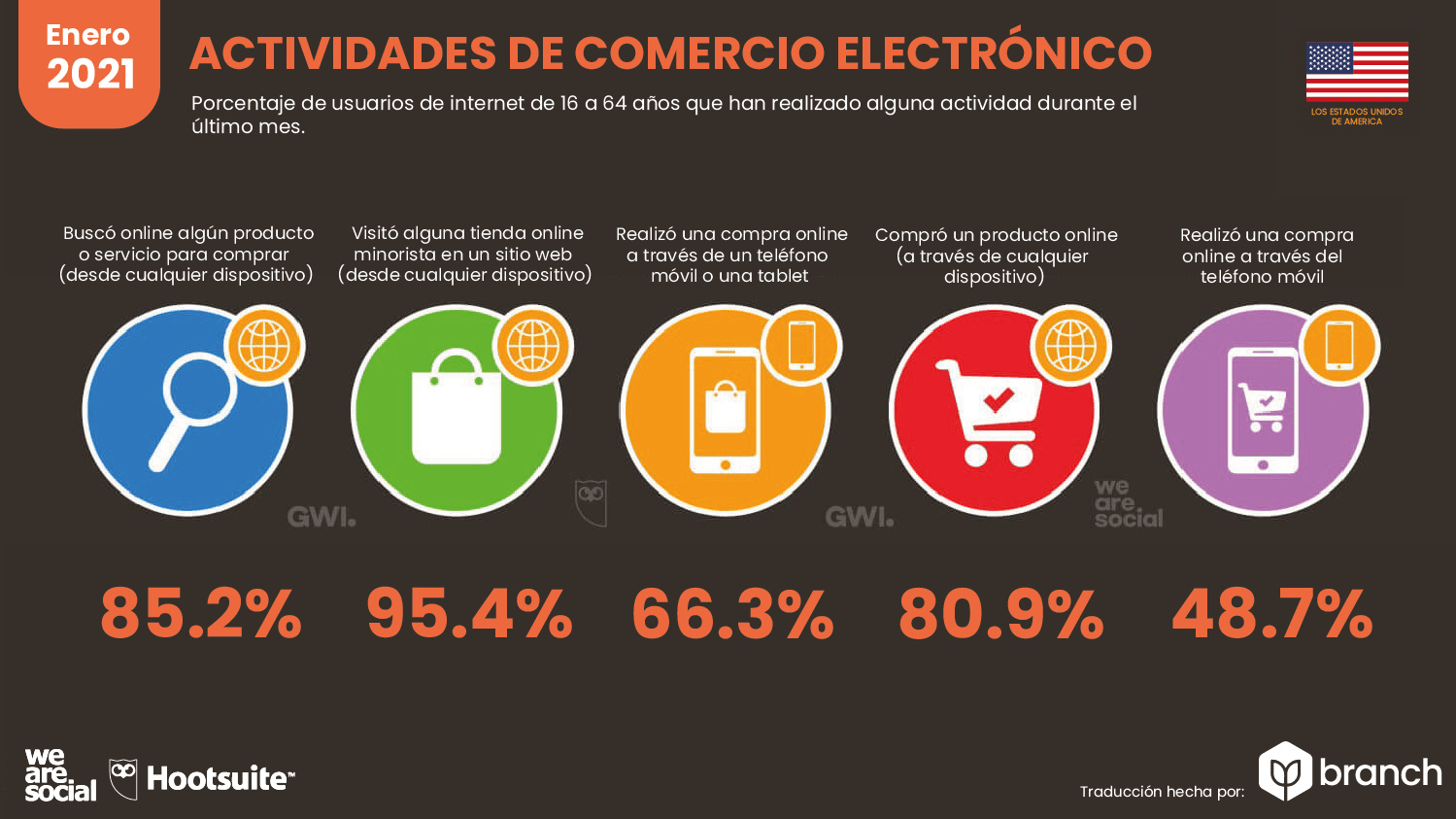
Ecommerce in the United States
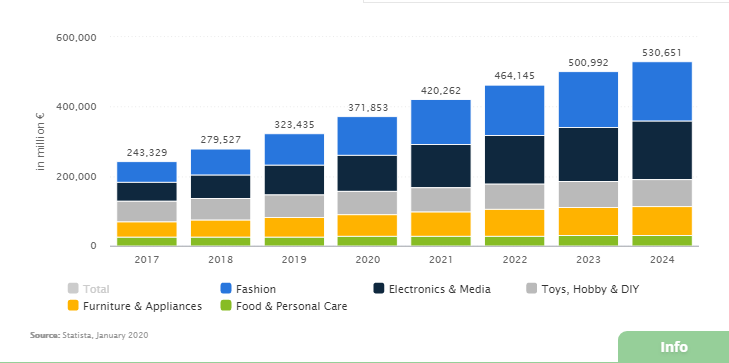
The most popular product categories for online purchase in the United States include electronics, clothing, home products, books and beauty and personal care items. In addition, U.S. consumers increasingly use their mobile devices to make online purchases. According to an eMarket report, they are expected to reach $477 billion by 2024.
Retailers have also adopted e-commerce as a key way to reach consumers and increase their sales. Many retailers have launched online shops, offer free shipping and returns, and have improved the user’s experience on their websites to encourage shopping. In addition, some retailers have adopted the “online purchase, pick up in the store” model to offer consumers the convenience of online shopping and the speed of collecting their purchases in the store.
Ecommerce trends in the United States
Amazon, the e-commerce giant, remains the market leader in the United States. In 2020, Amazon accounted for 39.8% of all online sales in the country, according to eMarket. However, competition is growing with the entry of traditional retailers into the online market. Large retailers such as Walmart, Target and Best Buy have increased their online presence and improved their shipping and delivery capabilities to compete with Amazon.
E-commerce in the United States is expected to continue to grow in the coming years. One of the main trends in e-commerce is customization. Retailers are using data and analysis to create custom purchasing experiences for consumers, allowing them to offer specific products and services based on consumer preferences and purchasing behaviour.
Another important trend in e-commerce is the integration of emerging technologies such as increased reality and artificial intelligence. These technologies allow retailers to offer more immersive and personalized purchasing experiences, which can increase customer loyalty and sales.
In addition, e-commerce logistics is expected to continue to evolve. Retailers are investing in technology to improve supply chain efficiency and reduce shipping and return costs. The use of drones and robots for package delivery is also expected to become a more common practice in the near future.
Sitelicon Ecommerce Services is a company specialized in helping brands and manufacturers in the online sale of their products, since 2005.
Editorial responsibility
Who is responsible for this content?
Sitelicon Team
Content created and maintained by Sitelicon’s multidisciplinary team.
- Publication
- Latest review
- Traceability
- 1 referenced source
Editorial archive
Recovered and dated content.
Content recovered from the Sitelicon editorial archive. Last update recorded on . The features and terms of digital platforms may change over time.
Related services
We can help you put it into practice.
For each article, we select the Sitelicon capabilities most directly related to the topic.
Amazon and marketplaces
We manage strategy, catalogue, advertising, operations and integration across Amazon and other marketplaces.
View service 02Ecommerce strategy
We select the right channels and define how they should fit into the brand's commercial strategy.
View service 03Integrations and automation
We integrate marketplaces with ecommerce, ERP, PIM and internal systems to avoid isolated processes.
View service