
Technology development and artificial intelligence
Apps in ChatGPT: a new channel for digital services
What the 2025 Apps SDK opened up and how to design useful services inside a ChatGPT conversation.
In brief
Key ideas
- OpenAI introduced apps in ChatGPT and the Apps SDK on 6 October 2025.
- Apps combine conversation, interactive components and authorised data or actions.
- The Apps SDK was introduced on MCP, an open standard for connecting models with tools and context.
- The opportunity requires clear utility, authentication, understandable permissions, privacy and measurement.
On 6 October 2025 OpenAI introduced apps that could run inside ChatGPT and released an Apps SDK preview. The model combined natural language, interactive interfaces and connections to external services.
This opened a channel beyond the traditional website or mobile app. A user could state an intent in conversation and use the relevant service in that same context to explore, compare, create, book or retrieve information.
What was an app in ChatGPT?
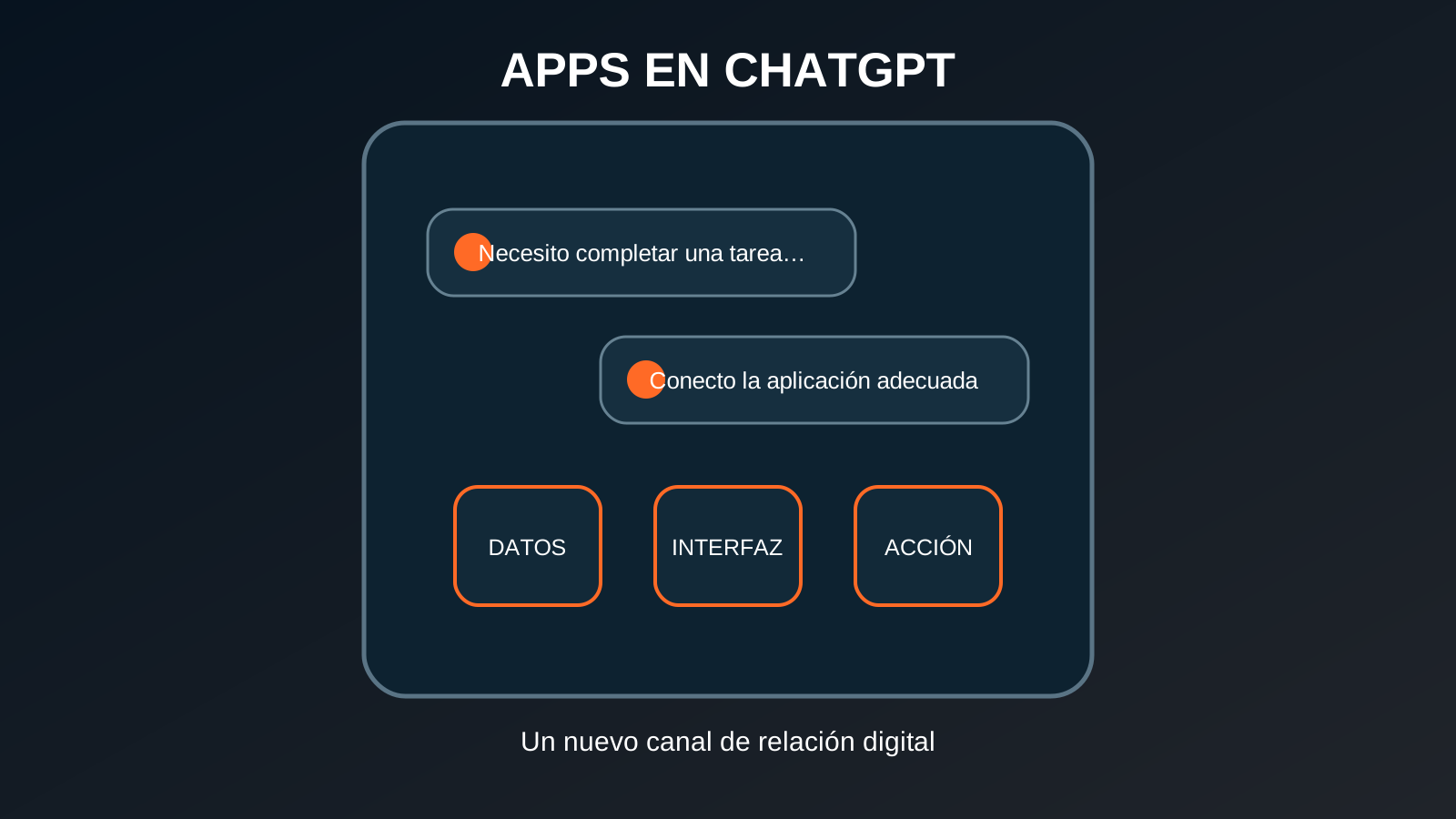
Apps could be called by name or surfaced when relevant. They could display interactive components and connect to a company backend for authorised functions and data. The Apps SDK built on Model Context Protocol—MCP—an open standard connecting AI systems to tools and context.
This was not simply a website embedded in chat. The experience needed to focus on one intention and use conversation to remove steps.
Ask four questions: what task does it solve, what data does it need, what can it execute versus ask the user to confirm, and what interface improves review beyond plain text? Copying an entire complex portal removes the conversational advantage.
A new point of entry
For years, organisations have structured their digital presence around menus, internal search and forms. In a conversational interface, the user begins by describing the desired outcome. This can surface a service at the right moment, but it also changes how the experience should be designed.
Opportunities for ecommerce and services
An ecommerce app can support discovery, comparison or basket preparation. A service business can calculate an initial configuration, check availability or create a structured request. Internal apps can retrieve documentation, prepare reports or start workflows.
Infrastructure comes first. Catalogues need consistent attributes, APIs should expose bounded functions and authentication must preserve user permissions. The app should request minimum data, explain sharing and separate reading from action. Purchases, publications or consequential changes require confirmation.
Catalogue, APIs and permissions
Privacy is not a paragraph added at the end of the project. It belongs to the complete journey: connection, consent, use of data and disconnection. Every function exposed to the model should have a defined scope and preserve the permissions of the authenticated user.
Design for trust
Conversational output may sound confident when data is missing. Show sources, conditions and states. Prices, availability, dates, scope and limitations should be visible. Plan for API errors, expired sessions, incomplete information and out-of-scope requests.
Measurement and evolution
Measure completed tasks, time, errors, abandonment, confirmed actions and satisfaction—not connections alone. Begin with one valuable task and expand from evidence.
How Sitelicon helps
Sitelicon combines custom software, ecommerce, integrations and AI strategy. Apps in ChatGPT showed that conversation could become an access layer for digital services. The opportunity is to provide a useful, safe action at the moment it is needed.
Editorial note: originally published in October 2025 and reviewed on 11 September 2026 to preserve the editorial archive.
Editorial responsibility
Who is responsible for this content?
Sitelicon Team
Content created and maintained by Sitelicon’s multidisciplinary team.
- Publication
- Latest review
- Traceability
- 2 referenced sources
Sources and updates
Verified and dated information.
Last update recorded on . The features and terms of digital platforms may change over time.
Related services
We can help you put it into practice.
For each article, we select the Sitelicon capabilities most directly related to the topic.
Custom software
We design applications and interfaces connected to real business processes.
View service 02Artificial intelligence and machine learning
We integrate models, context and tools with control and evaluation.
View service 03Integrations and automation
We connect APIs, data and systems so experiences can complete useful actions.
View service 04Consulting and digital transformation
We organise strategy, processes, technology and data into a prioritised, measurable roadmap.
View service